
Introduction
Artificial Intelligence (AI) has become one of the most talked-about technologies in clinical research. Every conference, webinar, and industry report highlights AI as the future of clinical development. Yet, despite the excitement and significant investments, AI has not transformed clinical research in the way many expected. Yes, AI has delivered value through document summarization, anomaly detection, report drafting, and automation. However, these remain incremental productivity improvements rather than transformational business outcomes. The question is no longer whether AI works—it clearly does. The real question is “Why has AI not consistently delivered meaningful business outcomes across the clinical development lifecycle?” The answer is simple: AI alone is not enough.
We Are Automating Tasks Instead of Transforming Clinical Execution.
Most AI implementations accelerate individual tasks such as writing emails, summarizing meetings, drafting documents, reviewing datasets, and answering questions. While valuable, they do not fundamentally improve how clinical trials are planned, executed, monitored, and governed.
Clinical Data Remains Fragmented
Clinical trials generate information across EDC, CTMS, eTMF, RTSM/IWRS, laboratory systems, imaging, pharmacovigilance, wearables, and EHRs. These systems operate independently, creating fragmented data and loss of business context.
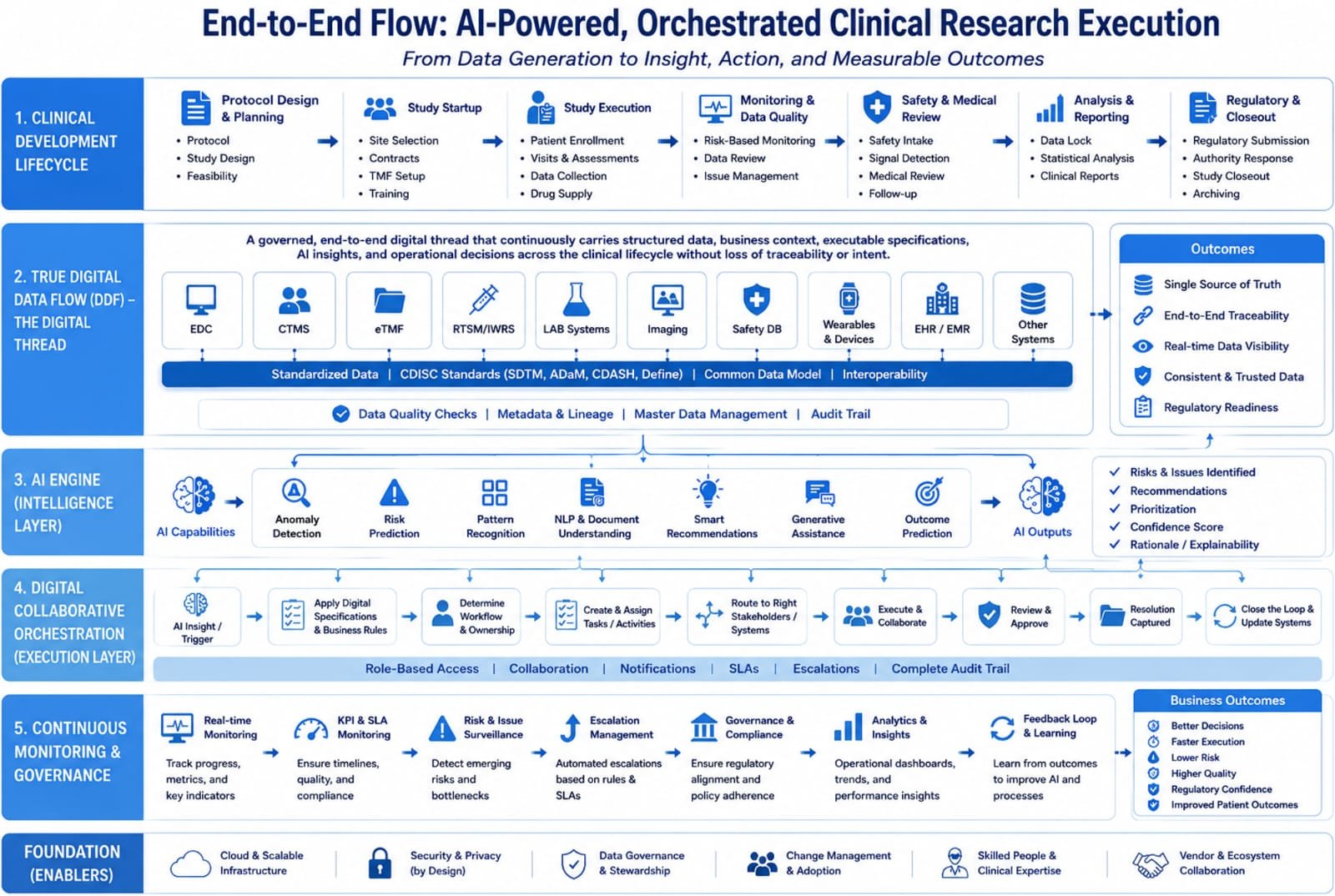
Clinical research requires a True Digital Data Flow—a governed digital thread connecting protocol design, study startup, execution, monitoring, medical review, data management, statistical analysis, regulatory submission, and study closeout. This preserves context, traceability, and governance while enabling AI to reason over the complete clinical lifecycle.
AI Still Lacks Clinical Context
Clinical AI must understand study protocols, CDISC standards, clinical workflows, therapeutic areas, regulatory requirements, safety processes, and operational procedures. Without this domain understanding, AI recommendations may appear convincing but cannot always be trusted.
AI Generates Intelligence—It Does Not Execute Clinical Operations
AI identifies risks and recommends actions, but recommendations alone do not create value. Every recommendation must be interpreted, routed, approved, monitored, escalated when necessary, and documented. This requires coordinated execution across the clinical value chain.
AI Needs a Digital Collaborative Orchestration Platform
Organizations need a Digital Collaborative Orchestration Platform that connects AI with people, workflows, enterprise systems, digital specifications, and governance. It should automatically route work, coordinate stakeholders, enforce business rules and SLAs, continuously monitor execution, trigger escalations, maintain complete auditability, and learn from outcomes.
Digital Specifications Make AI Reliable
Clinical operations require deterministic outcomes. Protocols, SOPs, workflow definitions, validation logic, business rules, and regulatory requirements should be converted into machine-readable Digital Specifications. These specifications provide the guardrails that make AI recommendations reliable, explainable, repeatable, and compliant.
The Future Is Intelligent Clinical Execution
The next generation of clinical platforms will combine five tightly integrated capabilities:
Artificial Intelligence: which provides the intelligence.
True Digital Data Flow: which provides the connected context.
Digital Specifications: which provide the deterministic execution.
Digital Collaborative Orchestration: which converts recommendations into action.
Continuous Monitoring and Governance: which ensures measurable and compliant outcomes.
Final Thoughts
The future of clinical research will not be defined by AI alone. The combination of connected digital data, executable specifications, intelligent AI, collaborative orchestration, and continuous governance will define the future of clinical research.
AI will become a truly transformative force across the entire clinical development lifecycle only when these capabilities work together seamlessly.